POLARIN · BILLING
Designing the invoice for complex NaaS Billing
One invoice. Multiple products. Mid-month upgrades. PAYG hours. GST variants. Three pages that had to serve a CFO and a network engineer at the same time
MY ROLE
Executive Experience Designer
OUTPUT
PDF invoice (With Annexture)
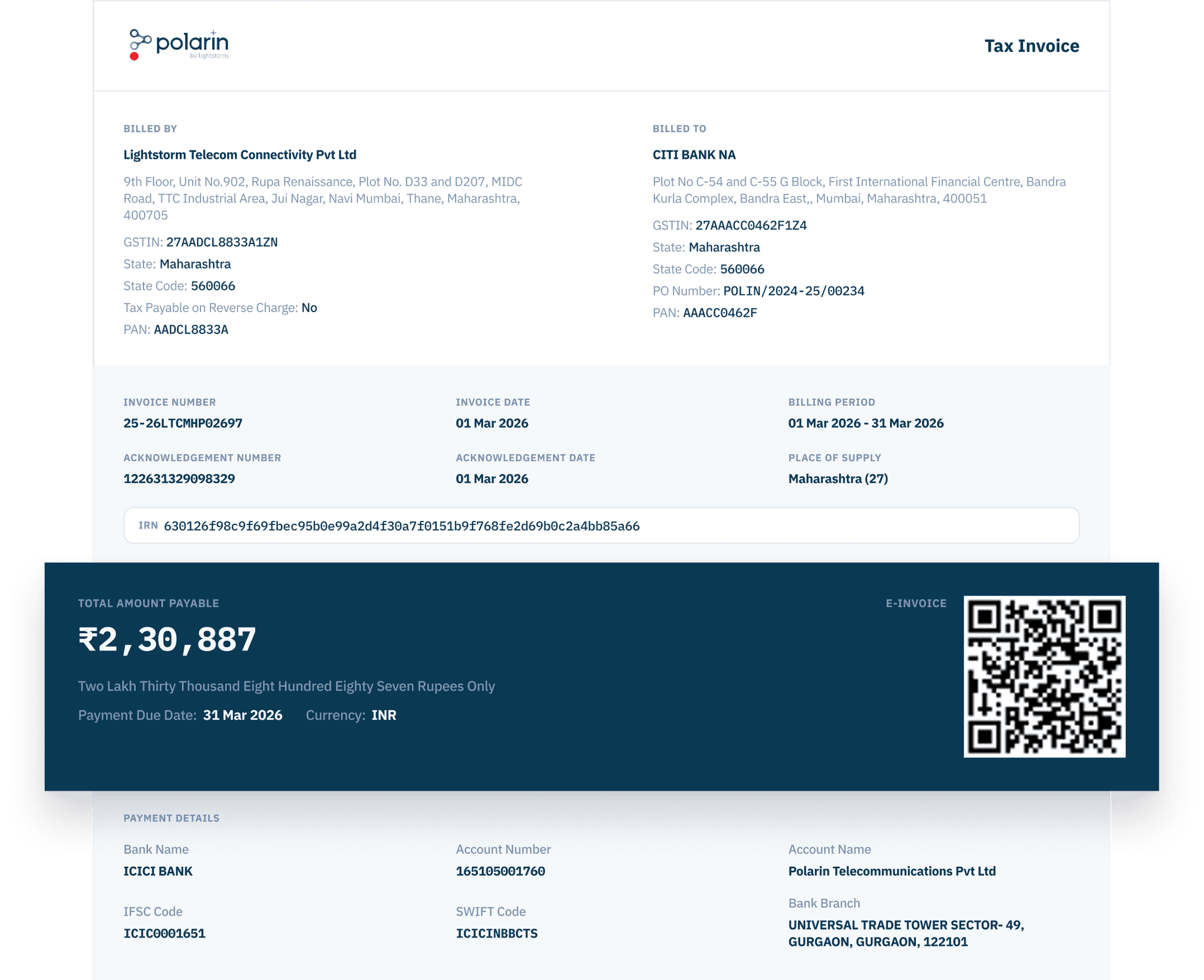
A ₹4.8L bill — with no explanation.
Polarin customers can buy a port, add a virtual connection on top, upgrade bandwidth mid-month, stack a PAYG add-on, then get billed — all in a single invoice. The old flat table had no hierarchy. Finance teams couldn't reconcile charges. Network ops couldn't match circuits to line items. Every bill triggered a support query.
Two audiences. Completely different needs. One document.
Not one problem. 4
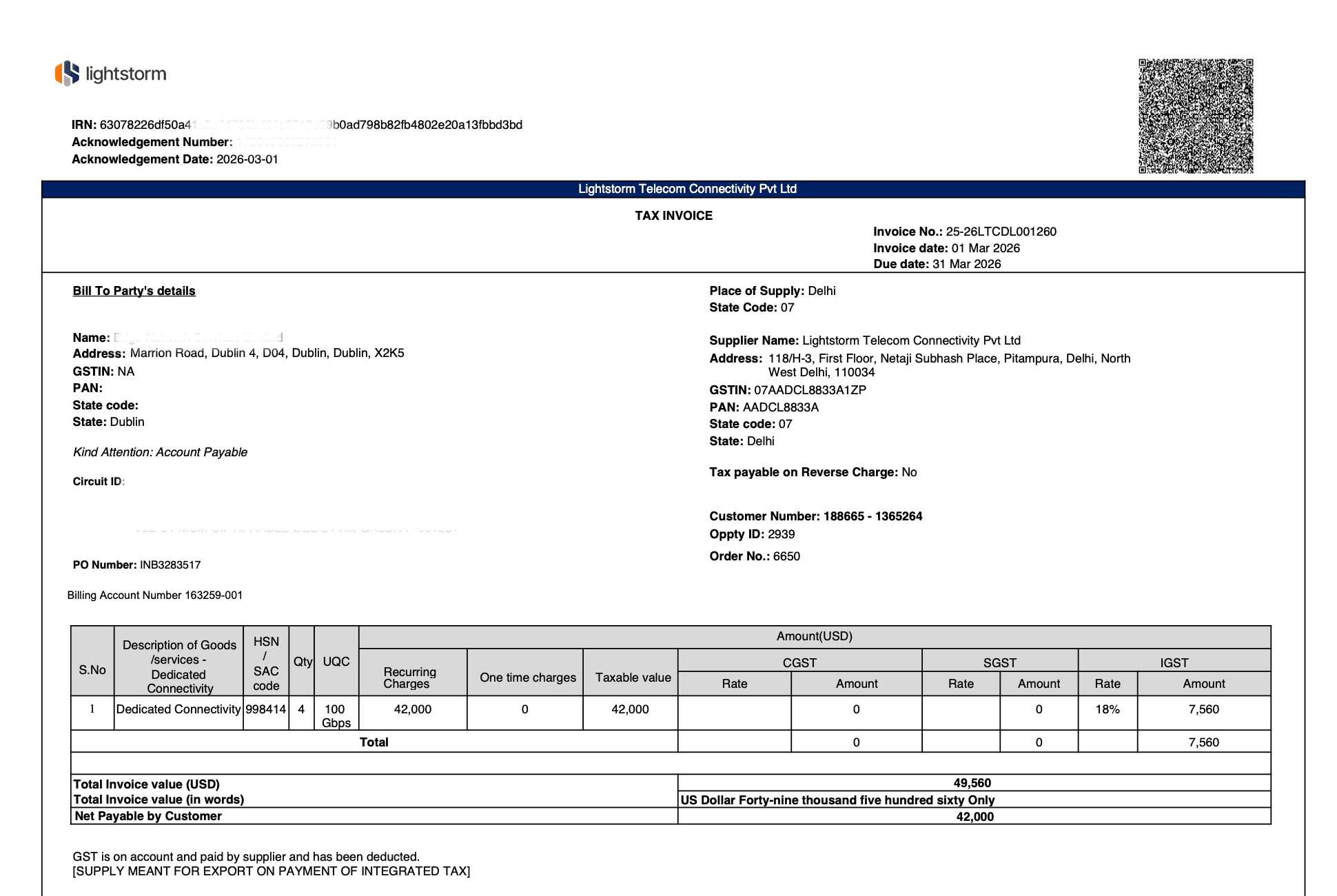
↑ this is what finance teams had to make sense of
01
Products within products
A Polarin DCI port can have virtual connections as children. Both appear on the same invoice but with different billing logic, different columns, different terms.
02
Mid-month changes
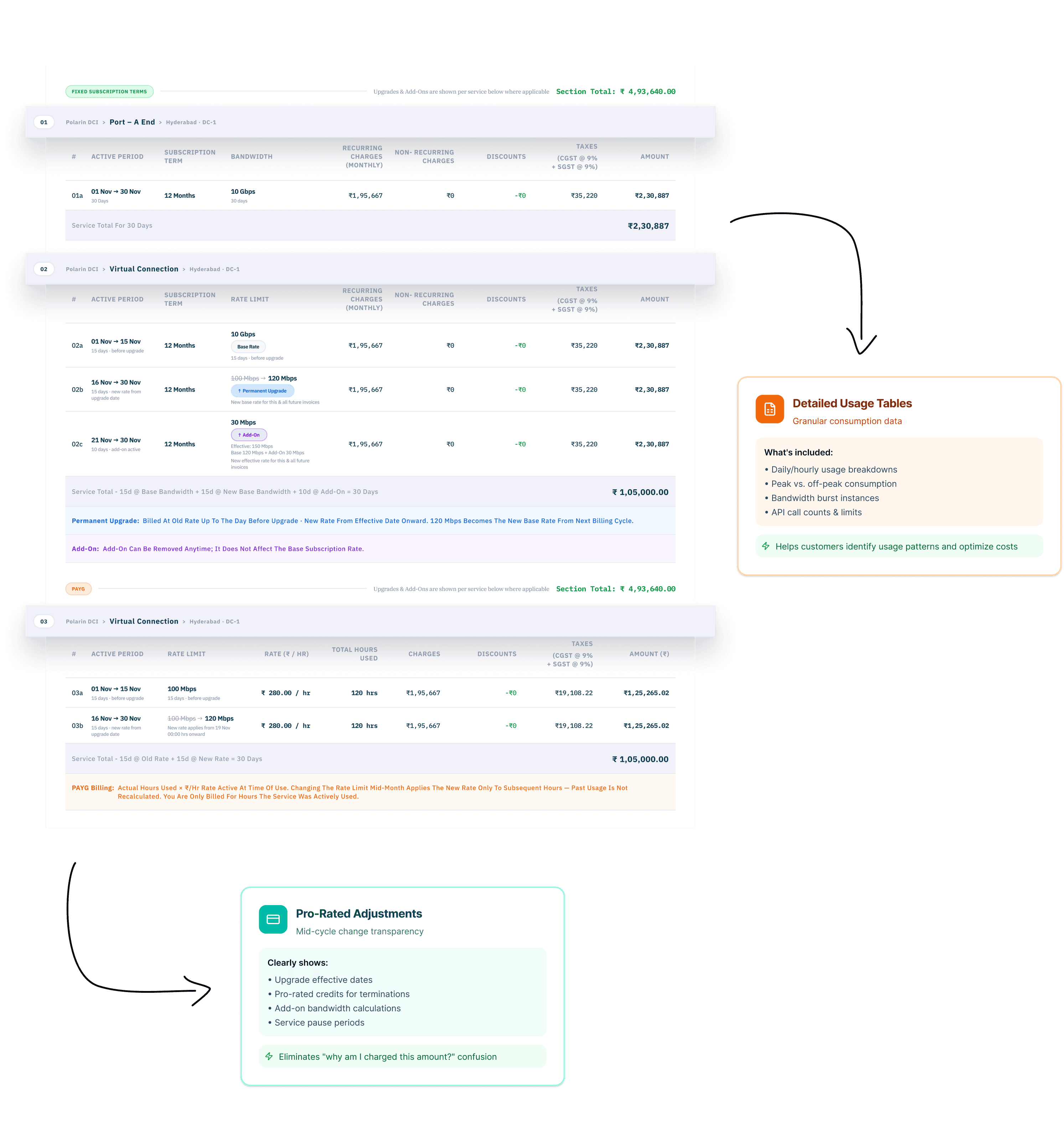
Upgrade on Nov 16 = old rate for days 1–15, new rate for 16–30. Add-On on Nov 21 creates a third tier. Three billing periods, one month, one row on the summary — with full drill-down on the annexure.
03
Two billing models
Fixed subscriptions (prorated days × monthly rate) and Pay-As-You-Go (hours used × ₹/hr) coexist in the same invoice. Different table schemas, different columns — both on Page 3.
04
Multi-currency + GST variants
International customers in USD. Indian entities need CGST + SGST split. Cross-state = IGST. Each variant is legally distinct and must be e-invoice compliant with IRN.
SOLUTION
Page 1
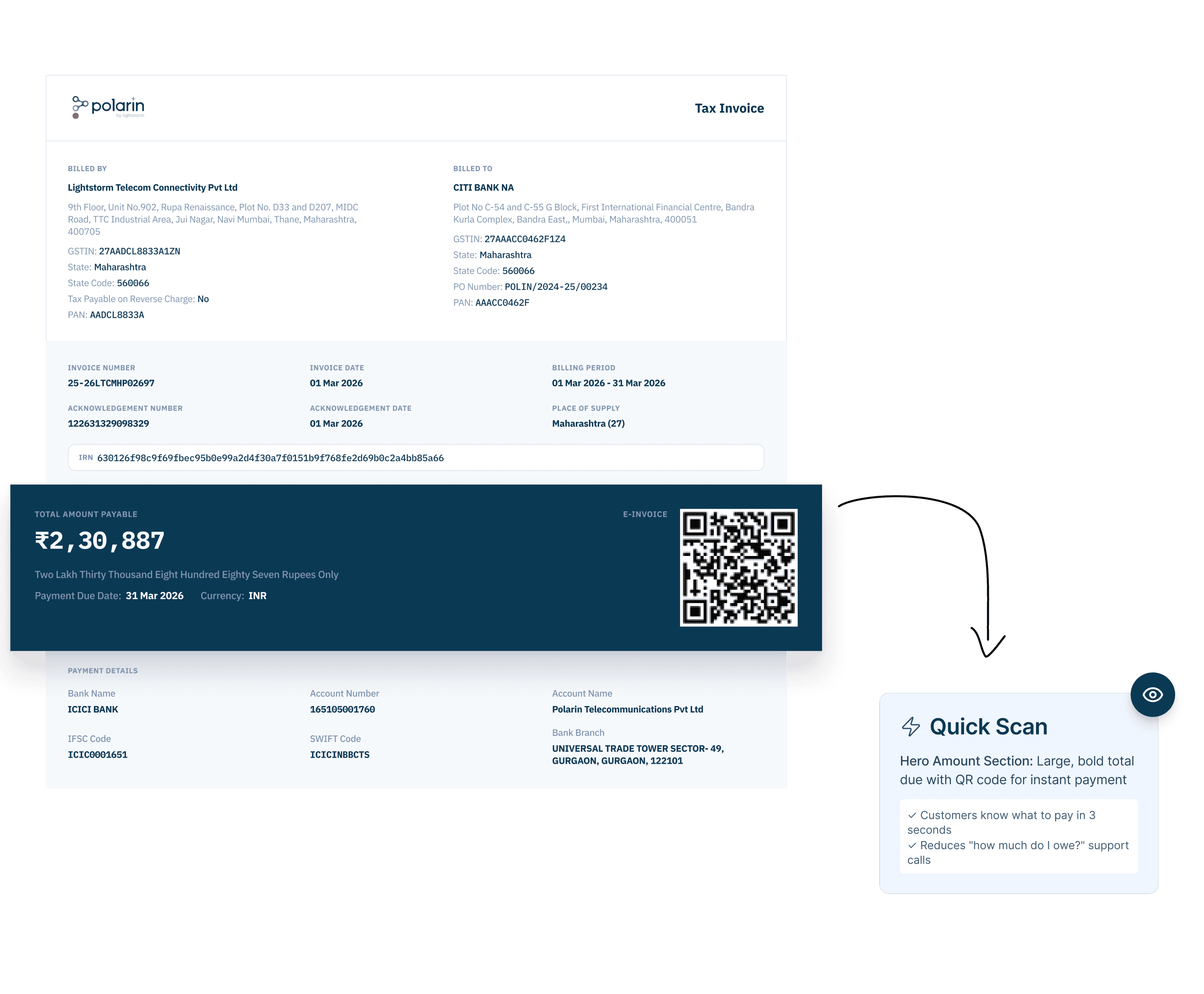
What do I owe — and where do I pay?
Billed by, billed to, IRN, billing period, total payable in large type, words, due date, bank details, QR. For USD — INR equivalent with live exchange rate.
Finance-first
Legal
Page 2
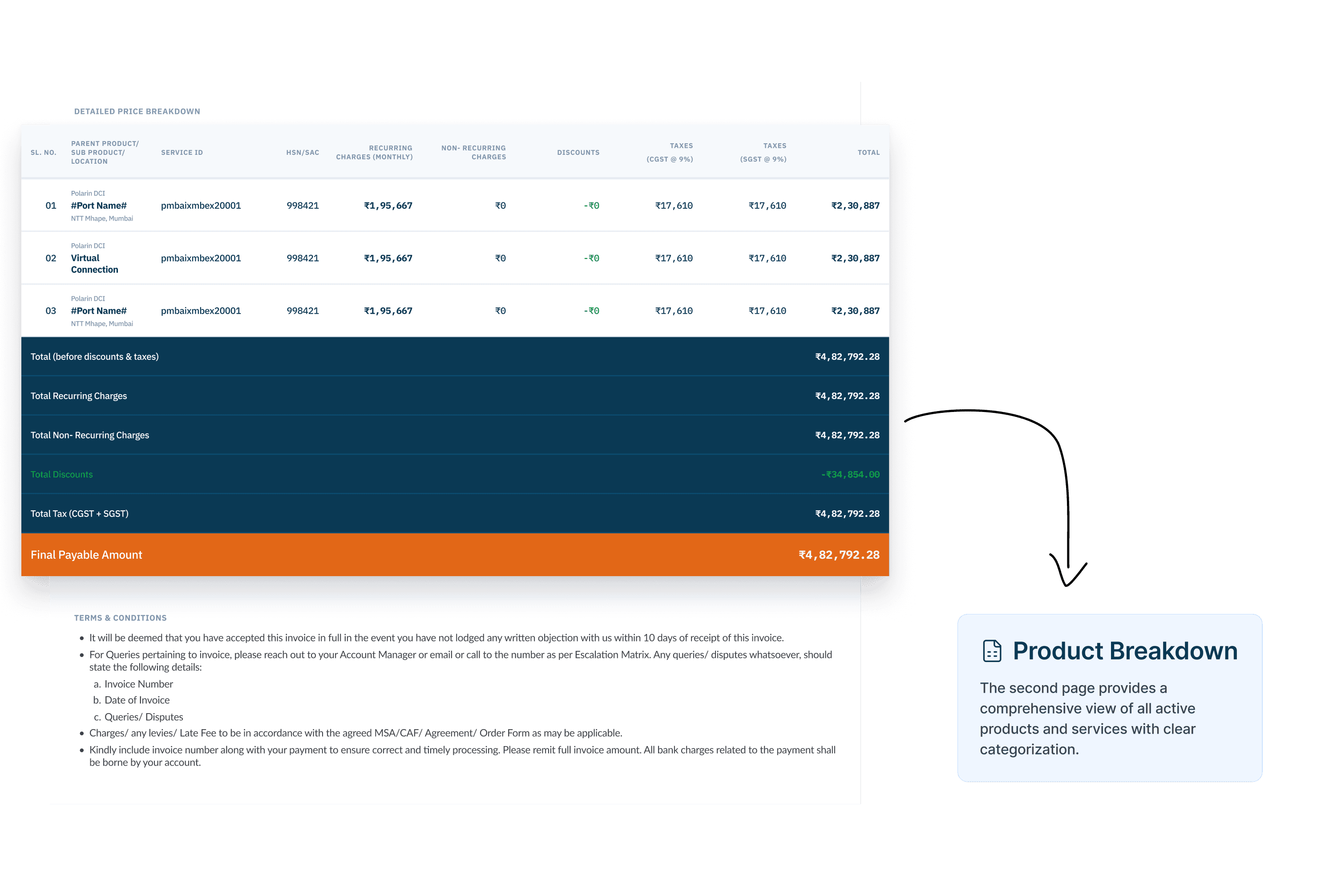
What am I being charged for?
Each product as a numbered row - parent › sub-product › location, service ID, HSN/SAC, recurring charges, NRC, discounts, tax, row total.
Sl. No. maps to Page 3.
Ops
Audit
Page 3 · Annexure
Why did my charges change?
Per-service tables with active periods, rate tiers, upgrade callouts, add-on stacking. Fixed and PAYG sections use separate column schemas.
Ops
Audit
THE NEW INVOICE
3D Globe View
The 3D Globe View brings the customer’s network to life. It offers a real-time, global perspective of active connections, regions, and performance alerts—making it easy to monitor network health and spot issues at a glance.
WHAT I LEARNED
Redesigning a document is redesigning the decision flow inside it.
The old invoice put everything on one page because it couldn't decide who was reading. Once we accepted that finance and ops have completely different jobs, the three-page structure became obvious.
Duplication in a bill reads as contradiction.
The summary table and the main table showed the same number. Finance teams filed tickets asking which was correct. Removing the duplicate wasn't a design choice - it was conflict resolution.
Scalability is a design requirement, not a nice-to-have.
The old format was a one-product template. The new one handles 768 circuits, mid-month upgrades, PAYG billing, international currency, and every GST variant - from the same system.